Kategori: Teori

  • Media genres in the exhibition

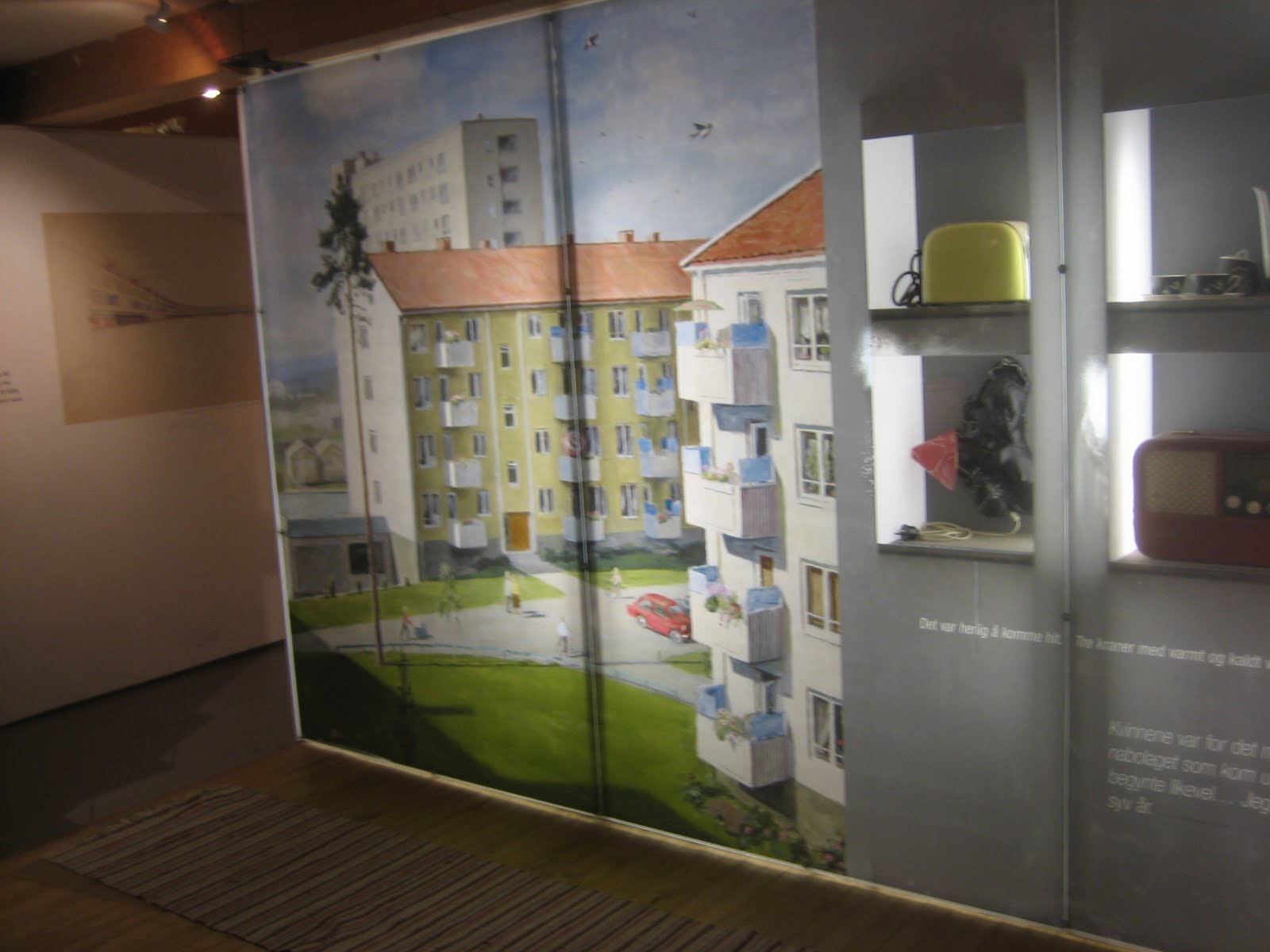
    p { margin-bottoIn the end of January, during my small tour in Norway, I visited the Museum of Oslo. The Museum of Oslo consists of three museums, Oslo City Museum, Oslo Theatre Museum and Intercultural Museum. At the City Museum I saw an interesting example of the role media genres play in exhibition design and how different media genres do affect how we understand a content. The example is a picture of a suburb exterior from Oslo, which is to be found in two different versions at the City Museum. The first one is the original painting by Arne Stenseng with the title Lambertseter 1957. This painting is hanging in the first room of the main exhibition which deals with the history of Oslo. This first room gives you a summary of the history of Oslo, and the painting is there to represent the building of new, and better, housing for workers outside Oslo, close to the nature. The other version of this picture is to be found in the temporary exhibition about the suburbs, or satellite cities, around the central parts of Oslo.
    As a part of this exhibition there are three small rooms decorated as suburb apartments from respectively the 1950s, the 1970s and one from around year 2000. The second version of the picture is used as an element in the 50s apartment. When you enter the 50s apartment you have a living room interior in front of you on the left side of the room. You see a couch, a table, a chair, a shelf with knick-knacks and some pictures on the wall, all typical for the 50s. On the right side of the room, the illusion of a real apartment is interrupted by a wall with four showcases. Under the showcases there is white text written on the grey wall. On the left side of the wall you find the second version of Stenseng’s painting. The painting is copied and blowed up so it covers the whole wall from top to bottom.
    Why is this example interesting?
    When I first saw the enlarged poster version of the picture, I didn’t know it was originally a painting, i.e., a work of art. The picture caught my attention because the rest of the exhibition relies heavily on enlarged black and white photographs. This means both the picture’s colors and the fact that it is painted, made it contrasts with the rest of the exhibitions illustrative elements. My first questions were therefore related to how drawings or paintings work differently in an exhibition than photographs. When photographs are used in an cultural history exhibition, it is with an unsaid promise that the photograph is showing how something was. It is giving you a peek into the past, and, to some extent, an objective peek. The objective character of the photograph is a debated subject and I will not go into that here, but I believe that for the general visitor, a photograph is mostly understood as direct impression of reality. Paintings’ and drawings’ relation to reality are different, because they are, in a stronger sense than photography, made by someone. We more easily doubt a painting’s trueness than a photograph’s. Therefore I wondered, what kind of role had the picture of the suburb exterior, why not use a photograph? Was it just a decorative element in the 50s apartment? When I then afterwards noticed the original painting in the main exhibitions first room, I became even more interested. Do the visitors’ understanding of the picture change when the picture’s medium changes? And how do we understand works of art in a cultural history museum?
    Some thoughts from the curator
    I was so lucky that I got the opportunity to talk with Linken Apall-Olsen, the head of Department for Exhibitions and Public Services at the City Museum, about these questions. She tells me that the version of the painting in the suburb exhibition make conversations among the visitors. Maybe, she wonders, it is because people look for a message in the picture. It is different from the photographs because it is carefully thought through by the artist, and not just a snap-shot like a lot of the photographs. The colors also gives it an own aesthetics, which is not only different from black and white photographs, but also from color photographs. Linken says she uses the picture a lot in her guided tours of the exhibition. The painting communicates some of the 50s optimism, and she points to the swallows flying high above the buildings, which refers to the proverb that says if the swallows fly high it will be nice weather. This makes the picture more than an aesthetic element, it also provides information strongly connected to the exhibitions message about how suburbs were understood and why they were build in the 50s. I ask if she talks differently about the original painting and the copy when guiding visitors. She answer that she usually mentions the painter’s name, when talking about the original painting, something she almost never do in the suburb exhibition. Here it is the different stories in the picture, like the swallows, that is important. These small stories are, literal, enlarged in the copy, and therefore get more attention.
    Nest step: theory
    I will follow up on media genres in exhibitions and this specific example in my next blog post. There I will introduce a media model developed by Lars Elleström, which I mean can be useful for theorizing media use in exhibitions. The purpose of Elleström’s model is to improve our understanding of the differences and the similarities between different media. I find this model very interesting for the understanding of the intermedial aspect of museums exhibitions, and it gives some terminological tools that might help us describe different media in the exhibition more precisely.
  • Interaction – with what?

    p { margin-bottom: 0.21cm; }a:link { }

    Interaction is a key-word in exhibition planning today. But what do we want the museum visitors to interact with? The museum personnel, the information communicated by the exhibition, the technology or the other visitors?

    One week ago I visited the new national centre of pop and rock in Trondheim, Norway, called Rockheim. Here you can, among other activities, visit an exhibition about Norwegian pop and rock from the 50s till today. The exhibition depends heavily on technology and the visitors interact with different kinds of screens in different kinds of ways, to get to know the history of norwegian pop and rock, which is told mainly by music videos, photos and newspaper articles. The exhibition opens up a lot of interesting topics, and I will probably write more about it in oncoming posts, but now I will use my experience of the exhibition to describe the above mentioned kinds of interaction.

    Interaction with the museum personnel

    At Rockheim they have made a quite brave choice by not adding any explanatory text to the media installations. This can be experienced as something negative, because you feel quite stupid when you don’t understand what to do. But, this has led to a lot of interaction between the museums personnel, walking around with their blue t-shirts, and the visitors, because most visitors have to be explained how the different installations work, something I find very positive. I think it really does something with the ambience in the museum. What is more scary than the silent museum guard sitting on his chair in the corner, just watching? The last year I have been working at the Karen Blixen Museum outside Copenhagen. Here the museum guards let the visitors in to Karen Blixen’s private rooms every half hour, and give a short introduction to the museum before the visitors can walk around on their own. This means that I say hello to each and every guest, and, because the doors have to be locked all time, I say goodbye when unlock the door and let the visitors out. I think this contact between the museum personnel and the visitors does something for the visitors experience of the museum. Both at the Karen Blixen Museum and at Rockheim this contact happens because of an inconvenience, a locked door and unclear technology, but the result, the interaction between museum personnel and visitor, I see as an advantage.

    Interaction with the technology

    It is fun to visit Rockheim, it is like getting a taste of how we in the future will be interacting with technology. You move in front of a screen, and the picture breaks like glass in small pieces and a music video starts. Or you point with a laser pen on a circle on a map and the picture on a TV-screen changes, when you point at another circle, another town on the map, another TV-screen reacts. Some of the installations at Rockheim gave me the feeling of only interacting with the technology, with this I mean that I only tried it to see what happened, not because I wanted to read more or wanted to see a new music video. The way the technology worked was the main entertainment. If you are interacting with the technology or the information depends of course on what your interests are, but it must be the goal of the curator to make people be interested in the information. I guess in most cases the interaction is included to make people get more information, not to make them learn about new technologies, except where the exhibition is about technology.

    Interaction with the other visitors

    Museums are often thought of as public meeting places, and maybe there is a wish from the museum that the visitors interact with each other. At Rockheim there are possibilities for interaction between the visitors, but I think it works best with the ones you know. There are lots of places where there is room for more than one participant at the time, but nowhere do you need to be more than one to handle the installation. This means you only interact with other visitors if you want to, and therefore probably just with the one you are coming with. Then, it must be said that I was there on a quiet day, so this may change if there is really crowded and and you can’t have an installation to your self. Also because the installations are difficult to understand you might start a conversation with some of the other visitors to find out what to do. Again, I think that people talking together in the museum is a good thing for the ambience, but it is not often you see exhibitions where interaction between the visitors is an important aspect.

    Interaction with the information

    This might be the most common goal when curators includes an interactive element in an exhibition. Every museum want the visitors to actively engage with the information the exhibition present. Interaction with information can happen on different levels. For example it could be that the visitors contribute to the information, by writing messages to the museum or the other visitors. Another example can be when the visitor actively think something about what is communicated and act on this by choosing one specific topic to learn more about or when the visitor has to do something to get more information, and is focused on the information and not on the technology. Even though I some times felt I just interacted with the technology at Rockheim, I mostly felt I interacted with the information. One particular successful installation is a band bus, a room decorated like the interior of a band bus, with screens in front and on the sides acting like windows where you can watch the scenery the bus is «driving» through. Here you can sit in a good chair and read an electronic magazine. By touching the pictures in the magazine a music video starts in the «window» next to your seat, and you listen to the music through a headset. Even though the technology is very good, the content is more interesting. And most important, you get the impression that the technology is chosen to suit the content, not the other way around.

  • Let’s start with a visit to the Victoria and Albert Museum

    Last Friday I took my first trip to London after moving to Oxford. The purpose was to take a look at how media are used in the exhibition Diaghilev and the Golden Age of the Ballets Russes 1909 – 1929 at the Victoria and Albert Museum. The exhibition ended yesterday, so it was a bit optimistic to think I could use it as an example in my master’s thesis, but I wanted to see if media was used in an interesting way in it. And a trip to London to visit this wonderful museum was a good way to start the work on my thesis.

    Unfortunately, I didn’t plan my trip too well. I hadn’t managed to get in contact with the museum, so I didn’t have permission to take photographs, and since the exhibition had just three days left, there was a lot of other people who, like myself, wanted to see it before it closed down. So I cued through the exhibit with my notebook, trying to describe it as best as I could.

    The theme makes this exhibition quite interesting in relation to use of media, because how do you exhibit dance, movement and music? As an exhibition at the V&A, beautiful costumes, posters, paintings, drawings and photographs were of course central elements. These objects were supported by, not too long, texts on the wall. The whole exhibit consisted of several big rooms which each had its own colors and lightening effects. The colors were strong, red, purple, green, blue, yellow and black, and the lightening dramatic and theatrical. In each room there were films to watch. One type was filmed ballet performances. These films were projected on walls, and almost becoming a part of the exhibition architecture. Another type of films was showed on TV-screens placed in black boxes. These were much smaller in scale than the projections on the walls. On these TV-screens you could for example listen to and see a man talking about Stravinsky’s music. The man was placed on a background of drawings, photographs, painting and note sheets which moved and shifted according to what the man was talking about. On another screen you could see an interview with a choreographer and see him instruct two dancers.

    This way of using films in an exhibition is not very original or new, but in relation to the questions I will examine in my thesis, it is interesting. The interesting part is how the different types of films are presented. The ballet performances are presented as esthetic elements, and integrated in the exhibits scenography. The documentaries are presented as separate elements where neither the the picture on the screen or the box containing the screen have an esthetic function. They are of course esthetically in the way that you can perceive them, and they are part of the impression of the room, but I will argue that they were mainly sat up for informational purposes. You could say though, that the black box around the TV-screen has a solely esthetic purpose in the way that it is there only to make the TV-screen look better. It is not giving anything to the look of the exhibition, just removing something.

    Andrea Witcomb argues in her article «The Materiality of Virtual Technologies» (Cameron & Kenderdine 2007) that museums could take advantage of thinking about multimedia installations as objects. In this V&A exhibition I would say that the ballet films are presented as objects in the same way as the costumes and the posters, and given the same value, both as esthetic objects and as historical documents.

    But even though media installations here are presented as objects, it is still a divide between the objects and the supporting information in the exhibition. The information films are not given the same value as the objects. They give the visitor supporting information in the same way as the labels and the texts. This depends, though, on the visitors background. A ballet expert would probably get as much information out of the ballet films, as from the information films. But for the common visitor, even though they may pick up some information about costume and dancing style, the ballet films would mainly be an esthetic element, as probably intended by the curator.

    My master’s thesis will evolve from an interest in how media are used in exhibitions. Some of the questions I hope to investigate during the following six months are, among others: What are the intentions behind use of media in exhibitions? How do different media work together in an exhibition? How do media work in relation to the room? How do media function as historical evidence? What are the relation between the esthetic, the pedagogic and the informational role of media in exhibitions?